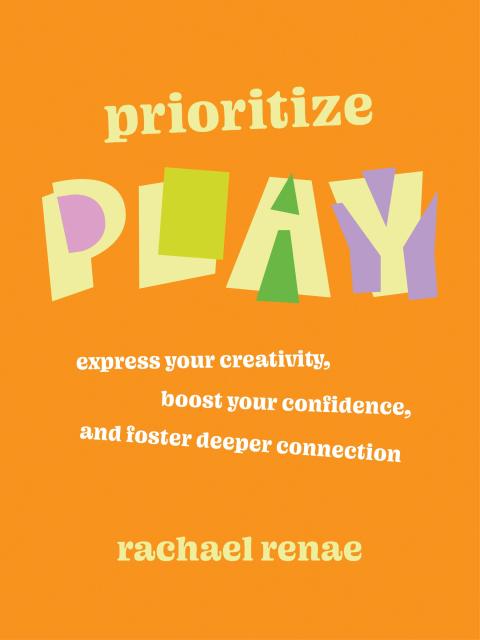
Prioritize Play
Express Your Creativity, Boost Your Confidence, and Foster Deeper Connection
Contributors
Buy from Other Retailers:
- On Sale
- Jun 9, 2026
- Page Count
- 256 pages
- Publisher
- Balance
- ISBN-13
- 9781538779040
You are creative! Yes you! Despite what society, friends, family, or social media might tell you, you don’t need to practice the “classic creative outlets” like art, music, or writing to find creative expression. And if you are interested in those outlets, you don’t need to pursue them as a career to live a more fulfilling life.
The key to cultivating the kind of big, juicy life that sparks joy, connection, and fulfillment isn’t chasing the title of “creative”, it’s prioritizing your play. In Prioritize Play, host of the Chaotic Creatives podcast and play enthusiast Rachael Renae reveals that play is more important to our wellbeing than productivity or career titles and should be prioritized as readily as getting groceries, paying your rent, or getting your work done. When we connect to ourselves through play, we become more curious and intentional in how we express ourselves and connect with other people. Within these pages are:
- Mindset shifts to start seeing play in the everyday
- Guidance to help you find your version of play
- Strategies to turn play into a regular practice
- Exercises to release expectations on your creativity
- Lessons in becoming your own hype pal
Through introspection and fun challenges, you’ll see that play is the solution toward overcoming our creative blocks, caring less about what people think of us, and showing ourselves that we do deserve to prioritize our creative ideas. Even when they don’t make money. Even if we’re not “good” at them. Even if they’re not a “traditional” creative outlet. Because we all deserve our version of our Big, Juicy Life!
Genre:
-
"With refreshing enthusiasm, Rachael Renae offers up her first book Prioritize Play as an invitation for us to investigate the many-layered process of authentic creative expression. Renae leads us down an illuminated path of permission, guiding us into self-exploration with a unique, bright energy that is both silly and supportive, simple and expansive. She reminds us that no matter our age, daily life can be a fun experiment filled with color and curiosity. With her generous reflections and exercises, Renae affirms that we all inherently carry our own wacky sparkle of artistry that is meant to be shared."Jacqueline Suskin, Author of A Year in Practice | @jsuskin
-
"I started Prioritize Play thinking it was a book about creativity, but it's actually a book about life. Rachael's book is stuffed with nuggets of wisdom, practical exercises, and tangible examples that will help you transform your mind, your creative practice, your LIFE into the one you've dreamed of living. It's a book you will devour on the first read, and return to again and again."Abby Mills, @abbyontheinternet
-
"Rachael is the cool art teacher and supportive big sister of your dreams. Her authenticity, vulnerability, and creativity are infectious. This book will change your life over and over again!!!!"Sam Reece, Author of Shitty Craft Club | @samreecetv
-
"This is the EXACT book our overstimulated, dysregulated brains need! A book about PLAY that is fun, inspiring, digestible and contagious! Whether you read the book cover to cover, or just pick it up to get a shift in perspective and mood, Rachael's innovative exercises, real-life-application, and researched based prompts are GOLD! "Alison Faulkner, Author of You’re Already Awesome | @thealisonshow
-
"This book is a permission slip to have fun again, both in and out of the studio. Rachael’s enthusiasm for play is simply contagious. I dare anyone to read this and *not* feel encouraged to begin creating a more joyful, creative life!"Lauren Hom, Designer, Muralist, Co-host of Chaotic Creatives | @homsweethom
Formats and Prices
Price
$14.99Price
$19.99 CADFormat
Format:
- ebook $14.99 $19.99 CAD
- Audiobook Download (Unabridged) $14.99
- Trade Paperback $21.99 $28.99 CAD
You May Also Like

An Excerpt from PRIORITIZE PLAY
author’s note
I wrote much of this book from my grandmother’s house in a small town in Michigan’s Upper Peninsula. I made the move from metro Detroit because my dad was nearing theend of his battle with soft-tissue sarcoma, a rare type of cancer that manifested as a total takeover of his lungs. I wanted to spend time with him while I still had the chance and be there to support him and my mom during his final days. What a heavy way to start a book about play!
Much of the work that I do around play may seem—on the surface—frivolous and silly. But as you’ll find out while you read this book, what I actually do is use play as a tool for staying connected to myself, for shifting to a curious and intentional mindset as I navigate life, and for strengthening my relationship to others. Life is as difficult as it is joyful, and often it’s both at the same time, as I’ve experienced so recently firsthand.
While experiencing this heartbreak with my family, I could have easily let grief and despair swallow me up—I am prone to romanticizing my life and a depressive episode makes for an interesting character arc! Instead, I chose to prioritize my play. To stay true to the work that I care so much about. To find little joys where I could. To ground myself with creative projects. To cackle with the people I love. I used play as a tool to stay true to myself as I navigated circumstances beyond my control.
And this is what I mean by prioritizing play. It’s intentionally choosing to create magic whenever we can. As I wrote this, my magic was an orange mug and a colorful blanket. It was snail mail and FaceTime dates with my best friends. It was thinking of the drives to treatment with my dad as quests we were embark- ing on together. It was giggling with my mom as we made dinner. It was hunting for the perfect rock on Lake Superior’s shoreline.
Play has changed my mindset, and that mindset got me through an incredibly challenging time. It still is as I make space for grief.
While this book is not a replacement for real-life therapy, it has come into existence from my own growth work—both with my therapist and in my personal practice. I use my creative practices, my therapy sessions, and play to work through life’s challenges—everything from identity, dating, ADHD, and, most recently, the grief of losing my father.
As you work through these pages, I hope that you’ll start to see how play offers us a path back to ourselves. Sometimes play is a lifeline, while other times, it’s the edible glitter on top of an already extraordinary experience.
introduction
Hi, I’m Rachael! Your hype gal for your journey through this book. I’m here to gab about play! I’m gonna tell you how I define play, why it’s so important, and how it can—dare I say—help you live your big, juicy, dream life!
First, though, I’m gonna hit you with a fact that you may not be ready to accept: You are creative! Yes, you! Despite what society, friends, family, or social media might tell you, you do have your own version of creativity. You don’t actually need to be interested in or practice the outlets we tend to associate with creativity like art, music, or writing to be creative or find creative expression. And if you are interested in those outlets, you don’t need to turn them into a career, be good at them, or make money from them in order to live a fuller life. I know this because I’ve gone through many iterations of my creative expression, including trying to make my art into a career, monetizing my creative hobbies, and continually coming back to my creative practices even when I don’t feel like I’m good at them.
I found the mindset of prioritizing play by working to understand my yearning. Though it absolutely tracks that I could be talking about the yearning I read about in my vast collection of romance novels, in this particular instance, I’m talking about the deep-in-my-gut feeling that I’m meant to live a big life full of creativity, confidence, and fun.
I, like many other practical people with bills to pay and responsibilities, thought it was too silly to devote too much time to my creativity. It’s a hobby, girlfriend; it can’t take priority! Our culture tells us that if we aren’t spending our time making money, we’re wasting it. If women aren’t taking care of other people first, we’re selfish. If your art isn’t deep or insightful, it’s not important. Capitalism prioritizes productivity, our self-worth is tied to our job titles, and generally, creativity is so buried that people think of natural human urges like play as frivolous.
During one of the many iterations of my creative exploration, I spent time as a hand-lettering artist and stationery designer. I did this in my spare time while maintaining a corporate job as an engineer (more on shedding that identity later). At first, this entrepreneurial journey was amazing—I was learning new skills, tools, print methods, and business practices. I started hosting workshops and teaching people how to hand-letter. I met other printmakers and artists and started to feel like I was a part of the community. I booked time in the letterpress printing studio and made weird prints and greeting cards with my hands and antique printing presses. I felt connected to my creative practice.
But after a couple years of trying to grow that stationery business—spending all my time, money, and energy on designing new products and emailing wholesale accounts and printing in my basement—I was still feeling depleted. Wasn’t this supposed to be nourishing? I didn’t feel excited about it anymore, but I felt like I “should” keep doing it because I had already come so far.
The more I focused on producing products, the less it felt like creativity. Though I was hitting societal and industry suc- cess markers, it didn’t feel good anymore. Anyone on the out- side looking in would tell you I was a creative, living a creative life. But I didn’t feel like it. I’ll dive into that a bit later.
That’s when I decided something needed to shift. I was determined to figure out why I was depleted instead of energized. I decided to take a step back from the creative practices I had been spending time on for the previous five years. I stopped hand-lettering. I (kind of) stopped producing products. I decided to give myself a creative challenge that wasn’t related to my small business. This was 2021—the pandemic was going strong, and I was stuck in a work-from-home rut wearing sweats every day. I decided I’d try something that seemed silly to some people: an Instagram style challenge. The goal was super simple: I’d create style prompts each week to help get me out of my comfort zone and experiment with my wardrobe (and hopefully feel more excited to work from home). I created a hashtag on social media to help me stay accountable, and I committed to posting every single day.
The style challenge quickly gained traction online. So many folks started following me, using the hashtag, and exploring their own wardrobes. Each month I’d hand-letter the style prompts and share them. One week was monochrome, the next was florals. I incorporated little nods to my values like thrifted Thursdays or sustainable Sundays to get people excited about secondhand clothes. What started as an attempt to make myself feel better each day turned into something I was completely jazzed about. Each day I was excited to experiment with my closet, yes, but also with the new Instagram feature: Reels (now so ingrained in our usage of that app!). I was having fun con- necting with people, talking about clothes, and learning about my self-expression. I was giddy thinking about what to pair together the next day or how I could come up with a unique challenge for the next month.
I realized just a few months in that I loved this. Like sugar-fueled-kids-at-a-carnival level fun. It’s all I wanted to talk about and all I could think about. The longer I experimented with my wardrobe and self-expression, and with connection online, the more I felt that feeling. The more I felt like myself.
What I realized I was actually doing with this challenge was playing. I removed the expectations of the final result having to mean anything. Clothes were such a low-risk way to explore my creativity. If an outfit was a flop, no big deal! I’d change. I kept reminding myself that tomorrow was a new day and a new challenge, so why not get silly today. Clothes allowed me to make an activity that I was already doing (putting clothes on for the day) feel more intentional, more creative, and more playful. It was still a creative practice—pairing colors together, finding boundaries and prompts to explore restriction, learn- ing what silhouettes, materials, and patterns I liked or hated on myself. The #rachaelrenaestylechallenge allowed me to use style as creative self-expression, grow a deeper understanding of myself, and ultimately build confidence in my authentic self. And though it wasn’t a goal of the challenges, I really solidified my understanding of my personal style.
But over time, the challenges started to feel constricting to me. As my internet following grew, I had more and more people wanting to just buy the clothes I was wearing instead of explor- ing their own personal style. I was frustrated because I thought that by showing up authentically, I’d encourage other people to want to explore in their own way. It was time for another shift.
I did some reflection on what I wanted my audience to take away from my challenges and content online. I realized that by only posting my outfits—which at first were in service to the creative challenge but then felt like obligations—folks only saw me as a style person. I wanted to change that. I wanted my internet pals to realize that clothes were the tool I used for creative self-expression. But how could I articulate that in a way that transcended various types of creativity? Anything can be a tool for creative self-expression, but how can we find those tools?
I wanted to show people that they, too, could create a silly challenge for themselves in any aspect of their lives they were excited about. But when I phrased this as “creativity,” so many people shrank away. I got messages like, “Well you’re so cre- ative, it’s easy for you,” or “But I’m not creative. I could never do what you’re doing.” Those limiting beliefs challenged me to articulate the same message in a new way.
What is a word that resonates with nearly everyone? What is so easy and effortless and childlike? Play!
Regardless of the expression (clothes, food, sports, art), if we’re playing, we’re doing it for the FUN, not for the final result. Everyone knows what play is, even if they haven’t done it in a while. I started thinking of all my creative projects as play. A new ceramics class? What’s a weird thing I could make that actually has no point? Repainting my bedroom? What if I play around with this paint color? It doesn’t have to be the final iteration. Play releases expectation and gives curiosity a path forward.
This attitude of prioritizing play had the same effect as the style challenges did for me in the beginning. I started making time for things like a weekly basketball game with friends. I illustrated, printed, and sewed together a deviled egg rating booklet for a vacation I took with a new crush. With each of these activities, I felt that giddiness again. Everything became an opportunity for play. And when everything is play, everything has the potential to be more fulfilling, more connected, and more inten- tional. My life began overflowing with joy and whimsy.
By prioritizing my play, I started to shed the things that no longer aligned with the life I wanted for myself. Relationships shifted as I spent more time with people who truly lit me up and shared similar values. I released expectations on those traditional art forms that I had always felt intimidated by. It’s just play! Who cares if I’m bad! It’s fun! By intentionally playing, I was giving myself permission to follow my curiosity, and that gave me clarity on the things that were the most energizing to me.
This practice of prioritizing play allowed me to detach my self-worth and identity from my job title (I was still working as an engineer at this point!) and put that energy into my creative work, my friendships, and my personal growth. I started to challenge the societal expectations on what a “good life” looked like and unpacking the strained relationship I had with my purpose. All of this stretching and challenge and discomfort was bearable because it was through the lens of play. It made it easy to grow more comfortable, to embrace the things that used to make me feel like an outcast, and to celebrate the qualities I had historically written off about myself.
And all of this is possible for you.
If you look up the definition of play, you’ll find a few common themes. Most circle around the idea of “engaging in activity for enjoyment and recreation.” Isn’t this the whole point of life? To do things we enjoy? Our play activities spark feelings of satisfaction, amusement, joy, and even contentment. But they also do so much more.
I’m here to tell you that play is more important to our well-being and general fulfillment than productivity or career titles. Play should be prioritized as readily as getting groceries or paying your mortgage or getting your work done.
With the everyday stressors of life in America—from the stripping of our human rights, to the increasing cost of living, to the disconnect and isolation running rampant in the digital age, we need more play and connection. Our society teaches us that we need to suffer in order to earn our rest, play, and joy. We don’t. And the research backs up the importance of play.
Back in 2018, NPR highlighted a paper in the journal Pediatrics that states, “Play is not frivolous. It is brain building.”1
And we’re not just applying that idea to small children any- more. A professor at the University of Chicago shared in his address to new students, “play is another word for experimen- tation, which is another word for learning.”2
I really love this language shift. If we can experiment and remove our expectations on the outcome, it’s just information we can use to improve our lives.
Yet, even with new information on play coming out every day, many creativity books I read are focused on labeling creativ- ity in that traditional way or teaching people to build a creative practice as a career. I actually don’t think we need to do that to experience the benefits of living a creative life, a playful life.
Because every single person is capable of creativity, and when we’re connected to ourselves through play, we are more fulfilled, more curious, and better equipped to find our perfect people.
My gal Julia Cameron (renowned author of The Artist’s Way, and regrettably not someone I know personally) says, “It’s not too late or too egotistical or too selfish or too silly to work on your creativity.”3 When I read that, it was the permission I needed to make whatever weird project I can dream up, from challenging myself to dress in monochrome colors to crafting a deviled egg rating booklet to curating a magical life full of wonder for myself.
Play is the solution toward overcoming our creative blocks, caring less about what people think of us, and showing ourselves that we do deserve to prioritize our creative ideas, in whatever form they take. Even when they don’t make money. Even if we’re not “good” at them. Even if they’re not a “traditional” creative outlet. Even if they don’t serve a big purpose.
This book is for anyone who feels the same yearning I did. Anyone who wants to feel more joy and curiosity and magic in their daily life. It’s possible, pals! And we don’t even need to quit our jobs and become full-time “creatives” (though I super back that decision if you do it). We can all take small, intentional steps toward prioritizing play in our existing routines. Those steps can help us create, grow, and connect. Those steps can help us live an incredible life that we get to define for ourselves. I’m going to share the structure I use in my courses and workshops and with one-on-one clients, so you can start prioritizing play right now. Within these pages are mindset shifts so you can start seeing play in the everydayness, strategies to turn play into a regular practice, and guidance on releasing expectations on your creativity. Play is about recognizing that we are all creative, and that creativity just shows up in different ways.
When we allow ourselves to play, we find what really lights us up. That discovery builds confidence and trust in ourselves, which allows continued growth toward our most authentic expression. Play allows time to decompress, to process the big feelings, to reflect. Because there is no forward progress with- out reflection.
But between all those big serious perspective-shifting topics, I’m also gonna hit you with silly exercises, prompts, and challenges so that you have FUN.
I’m jazzed you’re reading this, because it means you’re taking steps toward living YOUR version of a big, juicy, creative life!
And just like with everything I share, take what resonates and ditch what doesn’t. We’re all on different paths, and that’s beautiful!